
Setting Down the Blades | Part 8 of the Fruit of the Spirit Series
When we hold all the leverage to prove our case, the Holy Spirit calls us to a different work — gently pruning away the defensive reactions that drain our marriage.

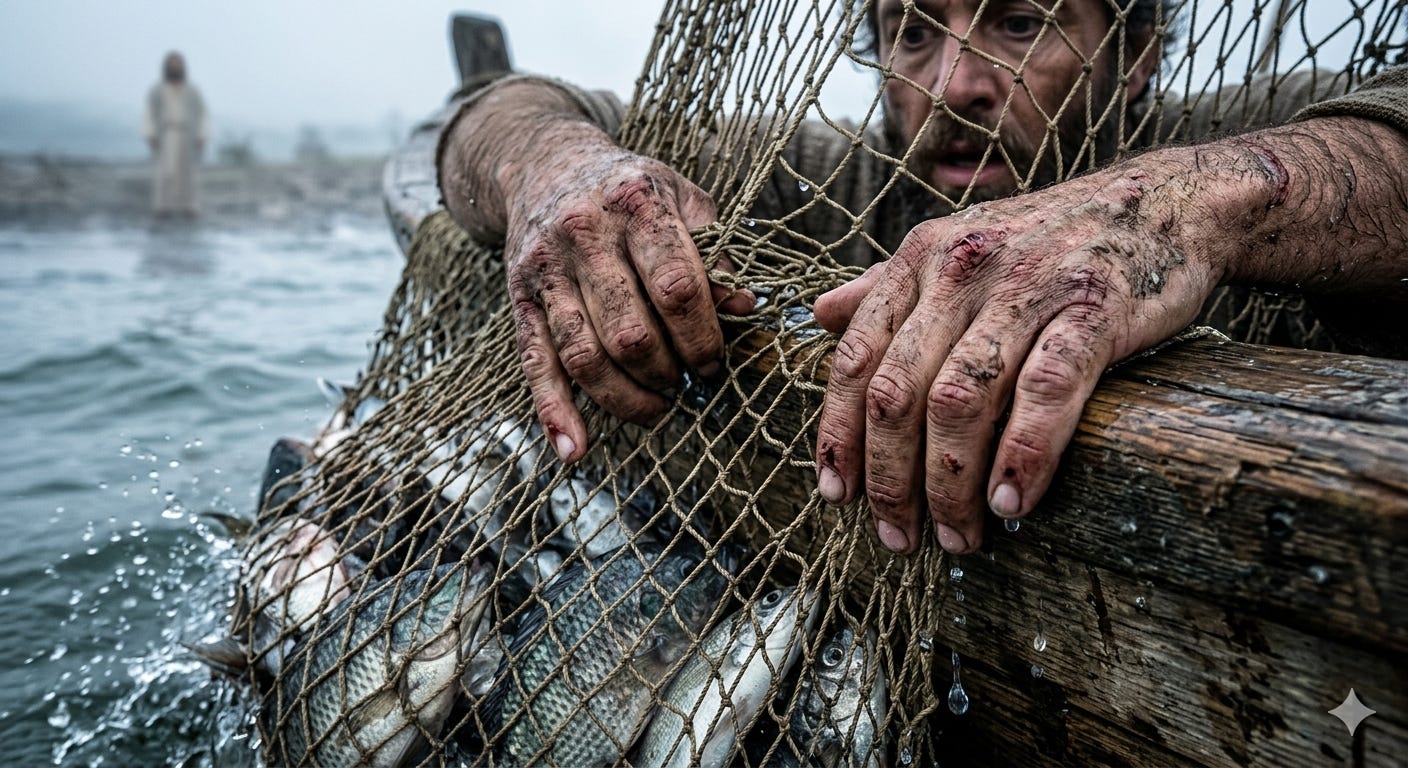
Peter sat there on the boat, hands raw and chafed, burning from pulling empty, wet flax — a perfect picture of who he was in his own mind. His eyes bloodshot and heavy, he caught a glimpse of his own hollow reflection in the glassy, pitch-black mirror of the water. He and his men had been at it for hours through the bone-chilling cold that had seeped into their knuckles and joints. It was the same thick cold that was slowly enveloping his heart.
Only days earlier, this same man who swore he would die for Jesus sat in the courtyard after His capture.
The fire.
The servant girl.
Three denials - each one more adamant than the previous.
The crow of a rooster.
Peter — Rock. Jesus gave him that name. Some rock. This rock had been catapulting down the side of a mountain of guilt now for several agonizing days. Peter had seen Him a couple of times, but words were never exchanged. What else was left for him but to do what he knew — fish. This was familiar.
The pungent stench of old seaweed and damp wood hovered above them. He walked gingerly across the slick deck, saturated with the morning dew and dotted with slimy, empty scaling baskets. Every hour, the heavy twine dripped uselessly in the bilge.
Looking out to the shoreline, it was lost in the ghostly mist swallowing the horizon. Standing there exhausted with his men, all they could hear was the rhythmic slapping of water against the weather-beaten wood. Everything in him felt as stagnant as the slop of flax laying on the torn up timber.
Rays of sun began peaking across the horizon dispelling the mist. Peter looked out. The silhouette of a man was walking towards them on the beach. He yelled out, “Friends, haven’t you any fish?”
“No!” they shouted back, voices flat with exhaustion.
“Throw your net on the right side of the boat and you will find some.”
It was an absurd directive to a crew of professional fishermen who had dragged the depths all night. Yet, something in the stranger’s voice carried an odd weight. They cast the net. Suddenly, the timber groaned under the weight of a thrashing surge of life.
Peter froze. The raw flax slipped through his bleeding fingers. He had lived this exact moment before. Three years ago, on this same lake, an empty night had been answered by a bursting net.
The stranger wasn’t a stranger.
In an instant, Peter was in the water, scrambling toward the shore. But as his feet hit the wet sand and he approached the warmth of a charcoal fire, a sense of hesitancy most likely gripped him.
What would He say?
Why was He here?
There he sat — the risen King. Jesus possessed all authority in heaven and on earth. He had conquered death itself. He held the ultimate moral leverage, the absolute right to demand an accounting. He had every right to look at Peter—the man who had cursed his name to save his own skin—and demand a defense. He could have crushed Peter with a single, righteous sentence.
Instead, Jesus cooked him breakfast.
He sat with him.
Spoke with him.
Reached across to bridge the gap.
This is the breathtaking landscape of Gentleness.
Power Under Control
In Galatians 5, when the Apostle Paul lists gentleness as a fruit of the Spirit, he uses the Greek word prautēs.
In the ancient world, this word was used to describe a wild stallion that had been thoroughly trained by a master. The horse had not lost its speed, its fierce spirit, or its immense physical strength; rather, its massive power had been brought under total submission to the rider’s will.
It was power under control.
Jesus on that beach is the ultimate portrait of prautēs. He possessed infinite power, yet He chose to hold it back. He didn’t use His leverage to humiliate Peter or to force a groveling apology.
Instead, He used a familiar miracle to gently whisper: “Hey, it’s me. Remember your friend? Remember who we are to each other?”
By setting the exact same stage as their first meeting, and building a charcoal fire to heal the memory of the fire where Peter denied Him, Jesus met Peter’s raw, shattered soul with absolute tenderness. He didn’t break a bruised reed. He didn’t extinguish a smoldering wick. He restrained His power to execute judgment so He could use His power to restore.
Setting Down the Leverage
There we sat, trying to unravel years of brokenness and pain. For so long we had become experts at holding “leverage.” It’s the kind of leverage that relies on a catalog of past failures. We knew each other for so long and understood the triggers. We were privy to each other’s deepest insecurities. It would be easy to use what we knew — the perfect, devastating comebacks that could cut each other down to the ground in a second. In any given argument, we held the “blades.”
When the Holy Spirit began the work of healing us, the hardest part wasn’t learning how to apologize; it was learning the restraint of prautēs.
It was the moment I realized that even when I was “right” in an argument—even when I held the moral leverage to prove my case and make him feel the weight of his mistakes—I had to actively choose to lay the blade down.
Gentleness in a healing marriage is looking at the person who has hurt you, recognizing how incredibly fragile they are under their defenses, and choosing to hold back your power to crush them.
It is the Holy Spirit steadying your hand and whispering to your angry heart: “Put down the blade. Sit with them instead.”
We had to stop using our history as weapons. We had to stand on the shore of our own wreckage, look at each other through the raw exhaustion of our survival, and let the gentleness of God recreate our first connection. We had to remind each other: “Hey, it’s me. Remember your friend?”
It takes massive, rugged strength to be that soft. But it is the only way a shattered heart ever feels safe enough to crawl back to the table.
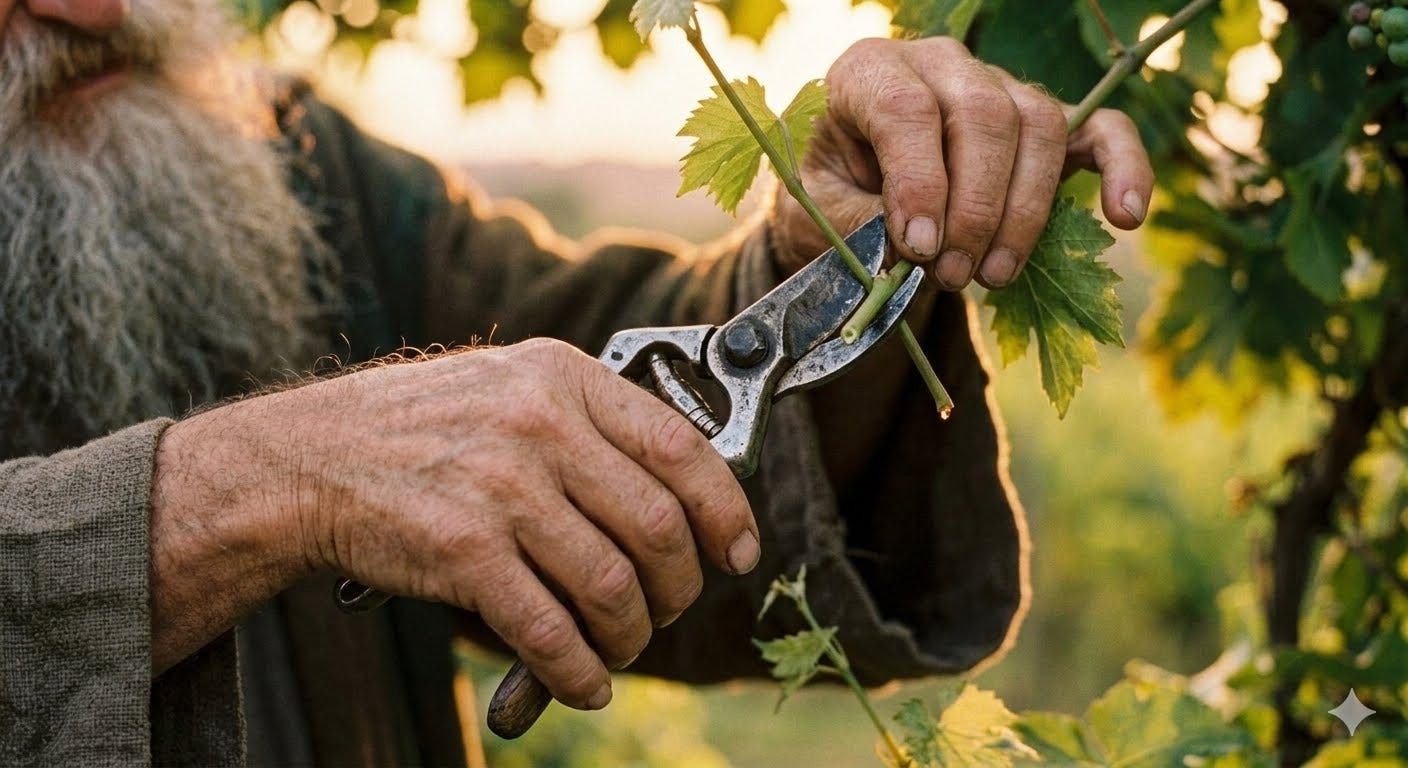
This is the gentle maintenance of the vine we’ve been growing over these last few weeks. In a vineyard, vines produce what are called “sucker shoots.” These are fast-growing wild leaves that drain the vine’s energy away from producing actual fruit. They may look lush and green, but they are parasitic to the harvest.
In a healing relationship, our defensive reactions — the passive-aggressiveness, the emotional walls, the sudden outbursts — are like sucker shoots. They are wild energy born out of our survival instincts. Gentleness is the process of allowing God to prune away those frantic, self-protective overgrowths so that the energy of the marriage can finally go toward bearing actual fruit.
A Moment for the Soil
True gentleness (prautēs) isn’t weakness; it is the ultimate expression of spiritual power. It is the conscious decision to restrain your right to hurt back.
If you are standing on a raw, vulnerable shore in your relationship today, look at what you are holding in your hands:
Where are you holding “leverage”? Are you keeping a mental record of offenses to use as weapons the next time things get heated? What would it look like to consciously lay that blade down?
How can you offer a bridge of remembrance? Instead of demanding a defense or pushing for a forced apology, how can you extend a quiet, familiar grace that whispers, “Remember who we are to each other”?
Where is the Holy Spirit asking you to be soft? Is there a “bruised reed” in your life right now that needs your restraint rather than your righteousness?
"I am the true vine, and my Father is the gardener.
He cuts off every branch in me that bears no fruit,
while every branch that does bear fruit he prunes
so that it will be even more fruitful.”
— John 15:1-2

Laura, the charcoal fire turns restoration into more than a conversation; Jesus meets Peter inside the memory of failure and changes what power will do there. Gentleness governs the form accountability takes, refusing humiliation while preserving truth, repentance, and repair. In marriage, setting down the blade can coexist with honest naming, firm boundaries, and protection from harm. Grateful for the way you showed Spirit-governed strength through the life it makes possible after injury.
Wow, what a powerful lesson here. I love how you explained gentleness in the context of hurt. There is a Spirit-empowered strength in that kind of loving restraint.